📝
Transforming Information into Solution!
In our modern digital age, information surrounds us everywhere we go. As we navigate the vast expanse of the Internet and engage with a multitude of digital platforms, we’re met with an abundance of information presented in diverse formats – text, sound, and visualizations. It’s a constant presence that shapes our daily lives! For example, in various fields such as transportation, business, and environmental science, we encounter tangible datasets housed in conventional databases. Additionally, we also come across different types of sequential data, including time-series datasets (stock prices, temperature, heart rate), text data (utilized in NLP research) and trajectory data (a sequence of decisions, vehicle or robot pathways and more).
As we increasingly immerse ourselves in this information-rich digital landscape, it’s absolutely crucial to recognize how profound its impact is and harness this influence to develop practical solutions for our daily lives. Yet, the question remains: how can we effectively leverage this information to address real-world challenges? A preliminary answer lies in the use of models. These models take the information as their input and, in turn, generate solutions. They essentially act as a bridge, connecting information to practical solutions.
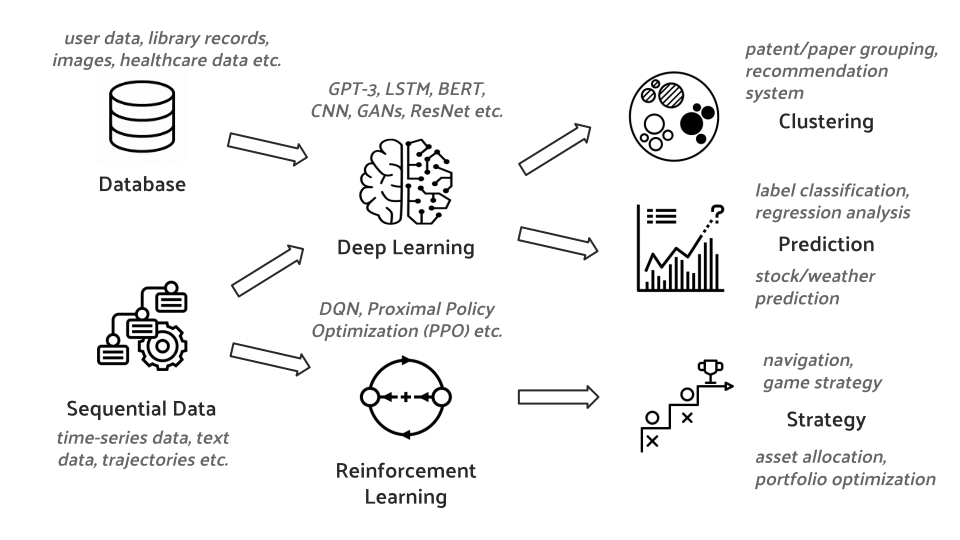
For handling conventional datasets, we can turn to statistical machine learning models such as random forests and Support Vector Machines (SVM) or neural networks for tasks ranging from prediction (classification, regression) to clustering. However, for sequential data, our toolkit expands to include specialized models. We employ time-series models like LSTM, generative models like transformer and diffusion models, as well as reinforcement learning to perform tasks such as forecasting, predictive generation, and the development of strategies to optimize expected returns.
Research Summary
My past research, consisting of two individual research works and several collaborative team projects, reveals two pathways as depicted in the above mind map. For the pathway of extracting information from databases using Deep Learning techniques for Prediction or Clustering tasks, I proposed a novel deep learning framework based on Siamese Networks using Triplet Loss to address name ambiguity in the PASTAS database. I’ve also been involved in other projects in the fields of computer vision (our paper), where we utilized GANs for image-to-image translation, and personalized investment (portfolioPro), in which we employed deep learning methods to predict risk aversion based on customer data. In the realm of utilizing Reinforcement Learning to extract strategies from sequential data, my honours year thesis focuses on exploring Multi-agent Reinforcement Learning algorithms to solve cooperative tasks. Besides, I also participated in an academic project where we applied RL for portfolio optimization and related work will be released soon.
Future Work
Alongside continuing my work on the two topics I’ve already explored, I aspire to dive deeper into the overarching framework illustrated in this mind map, transitioning from data to solutions. Specifically, my aim is to explore at least one of the following three aspects:
Firstly, I’m keen to investigate the pathway that encompasses sequential data, deep learning and prediction. This involves conducting research on time-series data and generative models, with a focus on their practical applications in domains such as stock prediction, weather forecasting (climate change), and NLP.
Secondly, I plan to delve into the realm of model enhancement. My objective is to explore how reinforcement learning can be harnessed to elevate the performance of various types of deep learning models. Conversely, I’m interested in the synergy of incorporating deep learning within the reinforcement learning framework to enhance overall efficiency.
Lastly, I intend to explore how each of these pathways within the mind map can be effectively utilized to tackle real-world challenges through data-driven solutions. Furthermore, I aim to investigate potential strategies to bridge the gap between theoretical research and practical applications, seeking specific solutions to facilitate this transition.